For a Full Screen View, click the icon on the right of the Slide Show's control panel.
On 23 May 2013, Guurrbi celebrated our 10th birthday! Here's a look back over the past 10 years, the story of how it all started, and some of the highlights along the way. It's been a wonderful journey.
More Picture Galleries...
About our tours
It's a great tour for kids
Guurrbi's Bush Creatures
Bush foods, medicines, crafts
Welcome to Cooktown

Voted Top Travel Blog!

Click here to see the full list of winners. We're very proud to be amongst such esteemed company. Our congratulations to them all.
Guurrbi on 'dream vacation' bucket list

Here's a snippet...
"Wilfred Gordon picks us up in an air-conditioned van at our hotel in remote Cooktown, in far northeast Australia... A Nugal-warra elder and story-keeper, Gordon is taking my companion and me out into the countryside to his clan’s private Guurrbi — sacred place — to see cave art drawn by his ancestors.
A walkabout in the bush with an Aborigine was high on my list of things to do in Australia. But it’s immediately clear with Gordon we have not signed up for some touristy indigenous offering. He informs us the lessons of the day will be in what he calls “the two s’s,” spirituality and survival...." Read more...
March 2013
Walkabout & Bush Lore
+crop4+(blog).jpg) |
| Collecting seaweed & crabs on Elim Beach, near Cooktown |
When people use the word 'walkabout' today, it conjures up an aimless wandering. But for Guugu Yimithirr people it was a survival strategy, strictly governed by local lore, and its direction determined by the location of food and resources. The land is fragile so the Bama of this region moved around with the seasons, always respecting the lores governing hunting and gathering in order to protect the environment which looked after them.
.jpg) |
| Wunha plums from the nonda tree |
+blog.jpg) |
| Wattle flower |
.jpg) |
| Nanggaarr-buurra - Kapok |
This is also the time to catch stingrays and a small, yellow, black-finned shark, whose livers take on a pinkish hue to show that they're full of oil. The fish oil is really important for a healthy diet, and helped keep us physically fit. The goanna is another animal from which we extracted the oil. Their fat is thought to be particularly good for preventing arthritis, and is best extracted before they hibernate during the wet season.
All through the year nature signals to us, so we know when the barramundi are plump, when river prawns and freshwater catfish are at their best, or sea urchins and native honey ready to be collected.
Importantly, bush lore also dictates what we can not hunt, although sadly, today, this is often ignored.
 |
| Wabul - Torres Strait Pigeon |
More stories about the bush...
Bush Messengers & Fishing Made Easy
The Return of Burriwi the Emu
Picture Gallery: Guurrbi's Bush Creatures
About our tours
The Artist & The Story-keeper

One of the mala (specialists) in Aboriginal society was the painter of rock art. He painted with ochre - a type of clay which comes in different shades (pictured above). The artists would work only in a certain location, and his pictures would reflect the surrounding environment - its plants and animals, stories and events. The only plants and animals he painted were those which had a practical use. He also painted mythical and spiritual beings, and art which explained a fable or spirituality.
The milbi malin, or story-teller, is the person selected to translate the paintings into stories. He may also be, like myself, the story-keeper, who is responsible for passing the stories on - an inherited position which was handed down to me by my father. The milbi malin's responsibility is to explain the mythical and spiritual context of the art, and be able to detect minor details - shapes, size, and the different colours - in order to fully translate their meaning.

For example, if you look at the painting of the Jiliburu here, you'll see that this mythical figure is painted with stripes, whilst the emu underneath is in solid colour. This shows us the difference between real and imaginary, practical and spiritual. Often the story-teller has to tread a fine line between truth and myth. It is his responsibility not to mislead his audience, and to make sure that they understand the difference.
When it was the time to paint, the story-keeper and the artist would get together, and would nominate a site which was relevant to the story. They would sit and discuss what images would be painted in the caves, and whether the painting was to be about an event, food, animals, plants or the portrayal of something spiritual or mythical, such as the Rainbow Serpent.
Maintaining the paintings
The story-keeper and the artist were responsible for the maintenance of the paintings. When the artist died, then his replacement would create a new layer of paintings. You can see this clearly today at Wangaar-Wuri, and also see how the style of the painting varies between the layers. Style changes are particularly evident in the way hands and heads are painted. In the Food Cave (below) there are layers of figures, each painted in a different style.

Hand stencils are found in rock paintings throughout the world. In the Nugal caves you can see examples of the hand on its own, or with part of the arm as well. The hand stencils are mostly of thagu, the left hand, which is regarded as the signature of that person. The left hand was used because it is the peaceful hand, whereas nganhthirr, the right hand is generally the first used in anger. The stencils are often in white ochre, which was sprayed through a hollowed bone to create the spray effect.
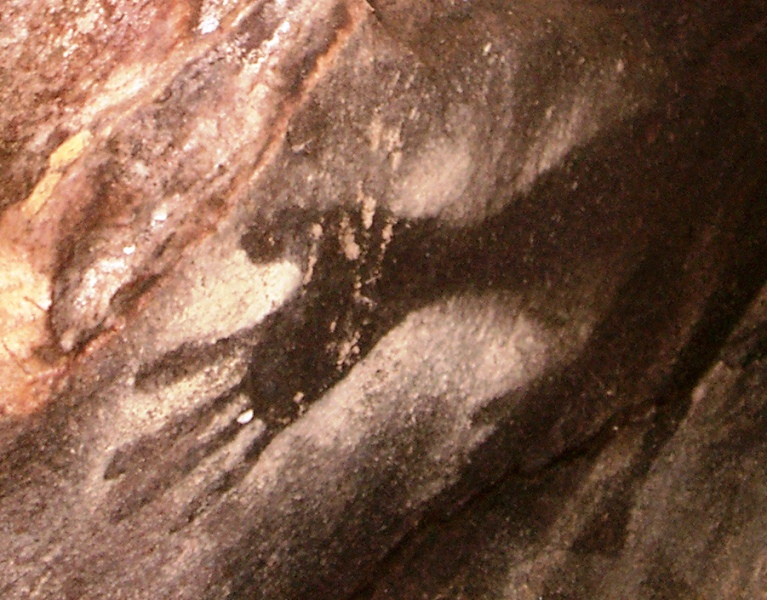
Adding your 'signature' to a place can also signify belonging or acceptance. One of the hand stencil sites at Wangaar-Wuri was made as recently as the 1930s and has a wonderful family story of reconciliation attached to it.
The Guurrbi Books

We've had such an amazing response to the stories we share in our blog, that we've now put them into print, in two 36-page booklets which are packed with information and photos.
Guurrbi: My Special Place focuses on the special area of my country known as Wangaar-Wuri, where I take people on tour - its rock art and bush foods, and the two 'S's' central to the existence of the Nugal-warra people - Spirituality and Survival.
Guurrbi: My Family & Other Stories continues sharing the knowledge passed on to me by my father, and answers some of the questions I often get asked on tour, such as why we have so many aunties and uncles, how we choose the right marriage partner, and what are joking and taboo relationships and brother-in-law language? It also includes some wonderful traditional stories (sometimes called Dreamtime Stories) from the region, and cultural information which sheds light on two important historical events, including Australia's First Reconciliation between Europeans and Aboriginal people on the shores of Wahalumbaal Birri, the Endeavour River, nearly 250 years ago.
My Family
 |
| Guugu Yimithirr c. 1896 |
I am a member of the Nugal clan, part of the Guugu Yimithirr tribe whose tribal area extends from the River Annan, south of Cooktown, to Princess Charlotte Bay. My grandfather on my father's side was the last of his brothers and sisters to survive the arrival of the gold miners and settlers, and to remain on his country. His name was Wunbuu, or Charlie, and he was born at the Birth Site on our clan lands at Nugal where I take people on tour.
Both he, and my grandmother, Minnie, worked for white people around Cooktown, but they weren't tied to any property or station. They were still controlled by the Police though, and every night would have to leave town after the curfew to join the 'fringe-dwellers' on the other side of Boundary Street, in an area now known as the Burrgirrku Reserve.
My Dad, Thulu (known as Tulo), was born around 1922. By this time Charlie was working for the Lutheran Mission's cattle operation on an outstation called Spring Hill, not far from where Cooktown Airport is today.
My Dad, Thulu (known as Tulo), was born around 1922. By this time Charlie was working for the Lutheran Mission's cattle operation on an outstation called Spring Hill, not far from where Cooktown Airport is today.

Here people hunted and fished, gathered seasonal foods, children played and swam in the creek and occasionally witnessed traditional dances. Away from the suffocating restrictions of the Mission, Charlie was able to share his stories and pass on his cultural knowledge to my Dad.
Then, in the late 1920s, my Dad was rounded up with some of his friends and taken to live in the Mission. Now he could only see his parents occasionally, and he was forbidden to practise or talk about his own culture. Only when Pastor Schwarz was put under house arrest in Brisbane during the Second World War, and the Guugu Yimithirr taken to an Aboriginal Reserve at Woorabinda near Rockhampton, were they able to maintain their culture again for a time.
After the war, the Guugu Yimithirr returned home and my Dad was amongst those who helped to build today's Hope Vale Community. The Church was strongly in control again (and remained so until 1986), but he did what he could to pass on the stories through his paintings, and also in the book Milbi he co-wrote with anthropologist and linguist, John Haviland.

Picture Gallery: On Tour with Willie
A Journey of 6,000 Years
 |
This photo of a Hope Valley man was probably taken in the early 1900s. The scars on his chest show he was man
of knowledge & understanding, and therefore a teacher.
|
Many people who come on tour with me ask what I think the future
is for Aboriginal Australians. They ask about the problems in our communities,
what is going wrong, and how things could be changed for the better. Some think
Aboriginal people should “pull their socks up” and make more of an effort to
become part of the economic society.
Yes, Aboriginal people today do have a big challenge on their
hands. But I think we need to stop and look at the big picture. We need to remember
the journey we are on—and when it started.
In the developed world people slowly stopped being hunter-gatherers
when farming was first introduced, around 6,000 years ago. This means they have
had 6,000 years of gradual adaptation and change to reach where they are today.
Aboriginal people in Australia started
making this journey 220 years ago — a frighteningly short time span for us
to catch up with modern society. Here on Cape York we've had even less time: my grandfather was born in the bush at the Birth Site where I take people on tour; my father's home as a child was a bark shelter.
When you consider the enormity of this journey, I think Aboriginal people have done astoundingly well.
We have people who are in Parliament, who are successful artists, sportspeople,
lawyers, doctors, academics. Families have children at University and we have
young people with PhDs. There are Mums and Dads who are employed, and work hard
all their lives taking care of their families. And we have people, like me,
with their own businesses. So whilst there is much that needs to be done
differently and which desperately saddens us, there is also much to celebrate
and be proud of.
 | |||
| Bulgan-warra Dr Damien Jacobsen with Dad, Bill. Charles Darwin University PhD ceremony 2010. |
If we are to make this journey successfully, education is the key. We have to learn the knowledge, skills and tools of modern society, and embrace the modern ways of learning too. But in our rush to catch up, we still need to maintain our cultural lores and values, and not allow them to be misinterpreted or simply forgotten. We might have changed the way we live—just as other societies develop and change—but we still need our cultural values and lores to keep us strong, and maintain our sense of belonging. That is why I share my knowledge and stories, in the hope that they will contribute to this end.
Mrs Watson & the story of Jiigurru, Lizard Island

These animals can be found at Jiigurru (Lizard Island), including manuya, the sand goanna (pictured) whose presence has always been a bit of a mystery. How did it get there? This is the explanation as told to me by my Dad, Tulo Gordon, and Fred Deeral.
The story of Jiigurru, Lizard Island
The shark and the stingray were living in the island's lagoon. They were talking one day and decided that, because the goannas shared the same beneficial oils, they would invite them to come to their island and live with them. This way the goannas could look after the land, whilst they would look after the lagoon. The stingray offered to go and fetch them, and use his broad back to bring them to the island. So off he went to Yuuru (now known as Cape Flattery) where the silica sands are, and there he found manuya, the sand goannas, and invited them to come to the island. He told them to get on his back so he could take them across the sea to the island.

The tragic tale of Mrs Watson


One of the Watson's Chinese servants was killed on Jiigurru. Mrs. Watson and the rest of her party managed to escape in an iron tank, only to later die of thirst on the waterless Number 5
island of the Howick group. You can see the monument to her memory in the centre of Cooktown, and a replica of the iron tank is in the James Cook Museum.
This tragic event took place in September 1881, and is usually explained by saying Mrs Watson and her party had unwittingly stumbled upon an Aboriginal ceremonial ground. But it is most likely it was because they were in the home of manuya, the sand goanna.
This tragic event took place in September 1881, and is usually explained by saying Mrs Watson and her party had unwittingly stumbled upon an Aboriginal ceremonial ground. But it is most likely it was because they were in the home of manuya, the sand goanna.
More stories from in & around Cooktown...
The Endeavour River story
The story of Barratt's Lagoon
The small town whose history changed the world
Picture credits
Lizard Island Resort (Lizard Island)
Mari Carmen Pineda (Sand goanna)
David Leu, S/V Leu Cat (Mary Watson's cottage)
Mari Carmen Pineda (Sand goanna)
David Leu, S/V Leu Cat (Mary Watson's cottage)
Warra & The Circle of Life

On our Rainbow Serpent Tour you will see both my family's Birth Site and a painting of dubal which was used when someone passed away.
In traditional Aboriginal society the Birth Place was a very important site as it marks the beginning of the Circle of Life and gives us our warra or spiritual identity. To give you an example, I describe myself as Nugal-warra, meaning 'I am Nugal, I belong to Nugal lands', just as you might describe yourself as Australian or English or German. We all need warra as it provides us with the strength we need for our journey through life.
The dubal was placed in a cave adjacent to the deceased's birthplace. This showed the Great Creator where the deceased came from, so that when the Circle of Life was completed his spirit would remain in the most wonderful place he knew: the place where his journey started and which gave him his spiritual identity.

During the time that the body was in the ground, close family of the deceased would put white ochre on their bodies to show they were in mourning. People seeing this would avoid mentioning the name of the deceased as a mark of respect, but they could use an alternative name if it was really necessary. The length of mourning depended upon the individual, but would not continue beyond the time the bones were removed from the ground, approximately twelve months later. This also ensured that any disease associated with the death was not spread to other members of the clan.
How it is today...
Nowadays, despite the Lutheran Church banning these cultural practices, some remain in a different form. Today bodies are buried in the Hope Vale cemetery with a funeral service which marks the start of the body's return to the earth. We celebrate the passing of the body into its spiritual form a year later with a tombstone unveiling ceremony. In many places it is still considered a lack of respect to mention the name of the deceased until this ceremony has taken place.
For many years it was also custom to close up the house of the deceased, and the family would move back in only after the tombstone ceremony had taken place and the house had been smoked. This custom had to stop because of the housing shortage, which is a shame as the smoking ceremony was a joyous event, marking the end of the long period of sadness and introducing happiness and joy back into the house again.
My Family
How it is today...
Nowadays, despite the Lutheran Church banning these cultural practices, some remain in a different form. Today bodies are buried in the Hope Vale cemetery with a funeral service which marks the start of the body's return to the earth. We celebrate the passing of the body into its spiritual form a year later with a tombstone unveiling ceremony. In many places it is still considered a lack of respect to mention the name of the deceased until this ceremony has taken place.
For many years it was also custom to close up the house of the deceased, and the family would move back in only after the tombstone ceremony had taken place and the house had been smoked. This custom had to stop because of the housing shortage, which is a shame as the smoking ceremony was a joyous event, marking the end of the long period of sadness and introducing happiness and joy back into the house again.
My Family
It's a great tour for kids!
If you have kids, don't think they'll be left out! Willie loves having them on tour, and there's lots of hands-on things for them to do - especially on the Rainbow Serpent Tour. Here's a scrapbook of photos very kindly sent to us by some of our lovely customers.
More about kids
The Reconciliation or Acceptance Story
.jpg)
In the 1930s there was a decision made by my clan to accept a little girl, my Auntie Ruby, into their midst, even though she had a lighter coloured skin. We called this event the Reconciliation or Acceptance Story.
First of all my Auntie Ruby, when she was old enough to understand, was asked to put her handprint in a cave to symbolise her acceptance into the clan. A hand stencil was made to give the hand's true shadow and to record that she was there. (Aunt Ruby's hand is the first on the left.) The stencil was made by blowing ochre through a hollowed bone to create the spray effect. Thagu, the left hand, was used as this is generally regarded as a person's signature, and because it is the peaceful hand; whereas nganhthirr, the right hand, is generally the first used in anger.
Then the artist and the story-teller sat down to document the event. They had to find a symbol they could paint to represent the story. So in a cave close to the handprint cave, they painted a big fish to symbolise the good decision made.
Then the artist and the story-teller sat down to document the event. They had to find a symbol they could paint to represent the story. So in a cave close to the handprint cave, they painted a big fish to symbolise the good decision made.
The reason they painted a fish is because when fish are swimming they sometimes turn and reflect the light. This is called gandal. Light has always been the symbol of spirituality, where good spirits are found. Darkness is where the bad spirits linger. So the reflection of the fish reminds us of how we should be accepting of all people, regardless of skin colour or culture.

You can see the big fish and the handprints, and hear more about the Reconciliation Story, on our Rainbow Serpent Tour.
Cooktown & The First Reconciliation
 |
| HMB Endeavour replica (Photo: ANMM) |
Lt James Cook's meeting with members of my tribe, the Guugu Yimithirr, at Gungardie where Cooktown now stands, is now recognised as the first recorded reconciliation between Indigenous Australians and Europeans.
I have told this story from our own perspective in 'Cooktown - a small town whose history changed the world'. Now here's the story from the viewpoint of Lt James Cook and Sydney Parkinson - and from Emeritus Professor of History at ANU, John Molony.
 |
| HMB Endeavour careened (Tim Johnson) |
In contrast, Cook's encounter with the Guugu Yimithirr at Gungardie was open and based on trust - the amicable relationship marred only by the refusal of Cook and his men to share the many turtle they caught. The story of the resulting hostilities, and the reconciliation which followed, is told in the in the Journals of Lt James Cook and Sydney Parkinson.
Cook's Journal, 19 July 1770
 |
| James Cook |
“In the AM we were visited by 10 or 11 of the
natives the most of them came from the other side of the River where we saw six
or seven more; the most of them were women and like the men were quite naked;
those that came on board were very desirous of having some of our turtle and
took the liberty to haul two to the gangway to put over the side; being
disappointed in this they grew a little troublesome, and were for throwing
everything over board they could lay their hands upon; as we had no victuals
dress’d at the time I offer’d them some bread to eat, which they rejected with
scorn as I believe they would have done anything else excepting turtle – soon
after this they all went ashore Mr Banks and myself and five or six of our
people being a shore at the same time.
Emmediately upon their landing one of them took a handful of dry grass
and lighted it at a fire we had a shore and before we well know’d what he was
going about he made a large circuit round about us and set fire to the grass in
his way and in an instant the whole place was in flames, luckily at this time
we had hardly any thing ashore besides the forge and a sow with a litter of
young pigs one of which was scorched to death in the fire –
as soon as they had done this they all went to a place where some of our people were washing and where all our nets and a good deal of linen were laid out to dry; here with the greatest of obstinacy they again set fire to the grass which I and some others present could not prevail until I was oblig’d to fire a musquet load with small shot at one of the ring leaders which sent them off; as we were apprised of this last attempt of theirs we got the fire out before it got a head; but the first spread like wild fire in the woods and grass.
 |
| Reconciliation Rocks, Cooktown |
Parkinson's Journal, 19 July 1770
 |
| Sydney Parkinson |
“And a little before we left the land; they
set fire to the grass around the spot where we had pitched our tent; but
luckily for us, most of our things were on-board; or they would, in all
probability, have been consumed as the fire burnt very fiercely; and had like
to have destroyed a litter of pigs; and some other thing.
We shot one of them who ran up a hill with a fore brand, and wounded him. Several of them came to us afterwards, and made peace with us.”
During his stay, Parkinson recorded 130 words of the Guugu Yimithirr language in his journal. It is likely that this was the first written record of any Aboriginal language in this country.
With thanks to the Cooktown Re-enactment Association.
More about historic Cooktown...
Picture Gallery: Welcome to Cooktown!Memories which last forever
Rhett Lego, CEO of the Conjoint Marketing Group in Germany, helped make a remarkable short video of Guurrbi Tours about five years ago. Recently he wrote his memories of that afternoon with Willie for German tour operator, Art of Travel, and sent us a copy. Here it is.
 "In my role of promoting Cairns and the Great Barrier Reef region across Europe and the UK, I have the pleasure of promoting some of the world’s greatest and most unique places, let alone the people in this remarkable corner of the planet.


- - -
Willie Gordon
"I have a belief that there will be about five memories in my life that I will take with me to my grave. One of mine will be of my time with Willie Gordon in his homelands north of Cooktown in Far North Queensland.

"On the morning I first met Willie in his country on his rock art tour, I was accompanying a group of five backpackers who we had recruited to be part of a film promotion we were shooting for Cairns. We had backpackers from Ireland, England, Antigua, Australia and Switzerland. We had had a rather large night in Cape Tribulation the night before and I remember telling them that I didn’t care what time they went to bed, but when they got up to meet Willie the next day, they had to remember the word: Respect.
"We drove up the Bloomfield track from Cape Tribulation to Cooktown and from there about and hour and a half further north of Cooktown to where Willie lives in his country.
"As we waited in the car park, Willie arrived in his understated casual way and introduced himself to the group. We all began an immersion into his country as he described the dreaming stories of his land as we walked along our path across an escarpment to the top of an open, rocky area that afforded us a remarkable vista over the country.

"As we walk, Willie quietly tells his stories and finds out more about our group of young and somewhat hung- over backpackers, who by this time were intently listening to every word he was telling us all.
"As we walked down a track toward the cave where the rock art is which is tens of thousands of years old, we come across a snake sunning itself on the track. Willie encourages us to walk quietly past where the snake had slid off into the undercover, leaving me in no doubt that he was silently telling the snake that we were OK and wouldn’t be any cause for concern for Mr. Snake. I hate snakes by the way, but somehow with Willie’s presence I sort of felt safe.
"We arrived at the rock art site where Willie allowed us to sit and gather our thoughts and bath in the splendor of the magic of this place. The backpackers were feeling the humidity and the impact of their late night. Owen the mad Irishman was sitting quietly on his own when Willie just sat next to him and spoke to him, telling Owen about parts of his life that he should not have known given that they had just met. Owen was a hard drinking, heavily tattooed loveable mad-man. But after a few minutes Owen was in tears responding to Willie's questions telling him about his early years of his life, which Willie somehow seemed to know all about.

"Meanwhile the young woman from Antigua was sitting quietly and Willie commented that he knew her mother was no longer with her but that she would see her again and that she was OK. The girl was both visibly shocked and at the same time remarkably calm as she and Willie proceeded to discuss how she had lost her mother early in her life, but that in their next life they would be together.
"Remarkable.
"Willie recounted his stories of his lands; of the cave art; of his ancestors and of course of his lessons in life which, whilst steeped in thousands of years of wisdom, are as relevant today and they have been over time.
"I sat in awe – not only at the remarkable spirituality of Willie the man, but at his incredible human insight and calmness. His tour was incredible; his passion for what he does and how he does it unrivalled; his ability to connect to people uncanny, and his warmth as an individual one of the most engaging I have encountered in my 50 plus years on this planet.
"I love one of the quotes on the Gurrubi Tours website which captures his spirituality brilliantly - “This is not just about Aboriginal rock art. It is about the present and the future and how we live.”
"The five hour journey back to Cairns was a quiet and reflective time for us all, with each of us knowing that we had just had an incredible experience. Owen the mad Irish man was quiet and reserved that night. He had been touched by Willie, as indeed had we all.
"As I write of these experiences, the hairs on the back of my neck stand up in memory of my time with this incredible human being. This is truly a man and a tour that you need to do – it will be an experience you will remember for life."
- - -
Thanks so much for sharing this, Rhett, and for the great short video which came out of the visit.
If you would like to see the video - and to meet Owen, the Irishman! - click the link. And here's the shorter version of the article in German which resulted.
Subscribe to:
Posts (Atom)






 Posts
Posts

